KFUPM Code:

SCE 594: Special Topics in Intelligent Automation and Robotics

Catalog Description:

In-depth exploration of geometric modeling and control techniques for robotic systems, focus on the application of Lie group theory. Students learn how to model and control complex robotic systems by leveraging the mathematical structures of Lie groups and Lie algebras. Key topics include rigid body kinematics, dynamics on Lie groups, feedback control design, and geometric integration techniques. Emphasis on applications to drones, robotic arms, and other mechanical systems. Combines theoretical foundations with hands-on implementation of control algorithms, prepares students for advanced research in robotics.

Course learning objectives:

  • Model complex robotic systems using Lie group theory.
  • Study and apply rigid body dynamics on Lie groups for both fixed-base and floating-base manipulators.
  • Analyze and utilize the mathematical structures of Lie groups and Lie algebras in control applications.
  • Develop and implement geometric control algorithms for multirotor UAVs, robotic arms, and other mechanical systems.
  • Integrate theoretical knowledge with hands-on implementation to prepare for advanced research in robotics.

New Additions / Modifications:

  • 2 more lectures on Mathematical foundations
  • Geometric Stabilization Control on SE(3)
  • Geometric Impedance Control on SE(3)
  • More Exercise Problems
  • MATLAB Tutorials on Manipulator Modeling and Control using “Robotic Systems Toolbox”
TopicSlidesClass NotesHomework/ AssignmentRecording (Youtube Link)
1. Mathematical foundationsLecture 1: Course Introduction & Set Theory BasicsLec 1 NotesLecture 1
Lecture 2: Maps between Sets and GroupsLec 2 NotesHW1Lecture 2
Lecture 3: Vector Spaces ILec 3 NotesLecture 3
Lecture 4: Vector Spaces IILec 4 NotesAsg1Lecture 4
Lecture 5: Vector Spaces IIILec 5 NotesHW2Lecture 5
Lecture 6: Manifolds and Lie Groups ILec 6 NotesLecture 6
Lecture 7: Manifolds and Lie Groups IILec 7 NotesLecture 7
2. Rigid Body ModelingLecture 8: Configuration space of a rigid bodyLecture 8
Lecture 9: Rigid body kinematics ILec 9 NotesAsg2Lecture 9
Lecture 10: Rigid body kinematics IILec 10 NotesLecture 10
Lecture 11: Rigid body dynamics IHW3Lecture 11
Lecture 12: Rigid body dynamics IILec 12 NotesAsg3Lecture 12
3. Fixed-base manipulator modelingLecture 13: Modeling Ideal JointsLecture 13
Lecture 14: Forward and Differential KinematicsLec 14 NotesLecture 14
Lecture 15: Dynamics of Fixed-base Manipulators ILecture 15

Lecture 16: Dynamics of Fixed-base Manipulators II
HW4Lecture 16
4. Stability and control of mechanical systemsLecture 17: Equilibrium points and Stability NotionsLec 17 NotesLecture 17
Lecture 18: Lyapunov’s direct method ILecture 18
Lecture 19: Lyapunov’s direct method IILec 19 NotesLecture 19
Lecture 20: La Salle’s Invariance Principle & PD Control on R3Asg4Lecture 20
Lecture 21: Stabilization Control on SO(3) ILec 21 NotesLecture 21
Lecture 22: Stabilization Control on SO(3) IILec 22 NotesLecture 22
Lecture 23: Stabilization Control on SO(3) III and SE(3)Asg5Lecture 23
5. Control of Fixed-Base ManipulatorsLecture 24: Motion ControlLec 24 NotesLecture 24
Lecture 25: Impedance Control ILecture 25
Lecture 26: Impedance Control IIHW5Lecture 26
Lecture 27: Impedance Control IIILecture 27

MATLAB Tutorials

Tutorial Series – Robot Modeling
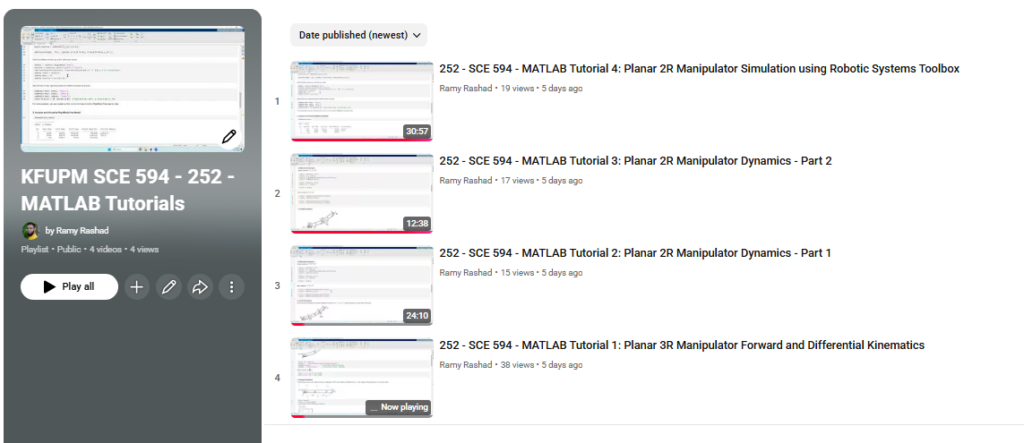
Youtube Playlist

Tutorial Series – Robot Control